Thursday, March 24, 2011

Hybridized Forms: The Postmodern Body & Identity


Orlan vs. Gaga

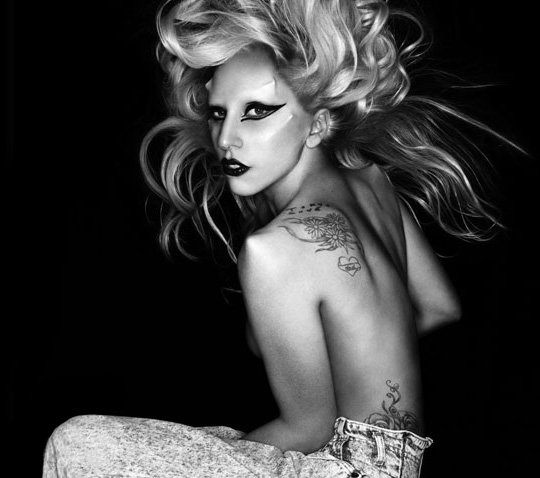
Two years ago I first heard about French artist, Orlan, who is best known for using plastic surgery on herself as an artistic medium. Not until she was brought up again in class today, did I ever think to compare her to Lady Gaga – but here it goes.

Both artists use their body as a way of sending a message. Orlan, however physically alters her body with surgeries. Gaga usually uses costumes, head pieces, sunglasses and different hair styles to alter her look. Orlan used her body as a medium for her art; Gaga claims her outrageous outfits, such as her meat dress, are sending out important messages. Does this make Gaga an artist, in the same light as Orlan? Or is she simply just trying to get on the front cover of tabloids each week with her over the top outfits? She said her meat dress had a very important message; no one knew what this message was until she explained days after she wore it. Some, like PETA, were outraged with her dress and some people still have no idea she was trying to send a message. Gaga’s most recent album “Born this Way” figures her with horns protruding out of the sides of her forehead, similar to those that Orlan had surgerically put on her forehead. The difference; Gaga’s horns were put on with make-up and could be taken off at any moment. Does this make her not as committed to her “art” as Orlan was? Or does it go back to the fact that Gaga was never intending on having a message or conveying art, she just wanted to be the centre of the “papa-paparazzi”?

Thursday, March 17, 2011

Postmodernism and Consumer Culture

Consumer culture has made its way online, newest trends are becoming more and more popular because everyone can access them online. People always want the newest, faster, strongest, best items. Now that we are able to purchase items online, we are more inclined to buy more items and those items that are the most popular. Even with facebook, while writing on your friends wall, there are suggestions for items you would be interested. With the fact that facebook takes facts from your profile on stuff you would enjoy, the suggestions are usually very relevant to you and more than likely have you clicking on that ad. People want the latest items and with the internet throwing those items in your face everytime you log onto the internet, it makes it hard not to want or purchase those items - thus resulting in so many people having the same items.

Thursday, March 10, 2011

Technological Innovations in 20th Century Popular Music


I knew that The Beatles Sgt. Peppper’s Lonely Hearts Club Band album was something very special and different but I did not know to what degree. This album took 9 months to record – whereas the first one only took 12 hours. It had a four track medium – meaning they did not all have to be there at the same time, they would record vocals and each instrument separately. It was released in stereo, so those unfortunate ones with mono speakers could not hear the whole album. And this was the first concept album – meaning the entire album had a theme. What was their concept? To create an alter ego band, named the the Sgt. Pepper’s Lonely Hearts Club Band. That is why the album artwork (designed by Peter Blake) features the Beatles twice. Once, in their normal clothes off to the side and again, centred in more unusual clothing, representing their alter egos. Interestly enough however, the Beatles in their regular clothing are actually wax figures of them, this really shows how they were this alter ego because they actually dressed up in these new outfits – they didn’t just throw some outfit on a wax model.

Looking behind and beside the Beatles they are surrounded with some familiar faces: Bob Dylan, Marilyn Monroe and Shirley Temple. They wanted it to be seen that all those cut outs of people on the album artwork were seen as ‘helping’ the band complete this album.

FUN FACT: Paul McCartney actually has an OPP (Ontario Provincial Police) badge on his left arm.

Thursday, March 3, 2011

Better Living Through Chemistry: Countercultural Environmentalism and Technology

Stewart Brand is an American writer who wrote the Whole Earth Catalog. Brand was also responsible for the button campaign in 1966, where he had buttons made that said, “Why haven’t we seen a photograph of the whole Earth yet?” Brand sent them out to NASA officials, members of Congress, UN officials, Soviet scientists and diplomats, Marshall McLuhan and Buckminster Fuller. He began selling them at Universities for twenty-five cents.

While majority of people suspected the Earth was just flat and infinite. Brand’s perspective changed when he was gazing at a San Fran skyline – with the little help of some LSD, he realized the buildings were not parallel, because the Earth seemed to be curving under them. Wanting to show everyone that the Earth was not just this infinite flat world, he needed something to prove this. He believed that seeing a photograph of the whole Earth would change a person’s perception. Having no one ever seen a photograph of the Earth, it made him even more curious. Earth, where we live, what does it even look like? Is it in fact round or flat? A photograph of the whole Earth, Brand knew, would be a very powerful symbol. Proving to all these people, changing their whole perspective on the world, that the Earth is in fact a sphere.

Thursday, February 17, 2011

The Media is the Message: Countercultural Political Protest

John Lennon and Yoko Ono met in 1966, married in 1969 and decided to treat their honeymoon in Amsterdam as a ‘Bed-in’ for peace event. Inviting hundreds of reports into their room, where John and Yoko spoke of non-violent ways of protesting wards and promoting peace. That same year they started ‘Acorns for Peace’ where they mailed one acorn each to 96 world leaders asking them to plant it for world peace. Later that year they held another ‘Bed-in’ for peace in Montreal.

John and Yoko’s objective was to use a calm, productive way to handle protest, promoting non-violence without violence. While it may be much harder to be a non-violent protester, I believe that in the end they will be the ones that are heard. However in situations like the G20 Summit, the violent protesters who were torching cop cars and vandalizing storefronts were over powering those that were peacefully protesting. It is very disappointing to know that after the G20 people would refer to ALL the protesters as dangerous crazy people who should all be arrested if they were not already. When in fact, yes there were violent protesters, but there also were peaceful, non-violent protesters who received very little attention, as they were over shadowed. Those that were violent and arrested may have got the media attention but realistically no one wants to hear what they are saying when they are extremely violent and vandalizing everything in sight. But those people take all the attention away from those non-violent protesters.

It is a difficult situation to be non-violent and without exposure, but if you stick by your beliefs, just like John and Yoko, the exposure will come and your message will get out there. It is highly ironic to protest non-violence WITH violence. So don’t! Obviously it helps to be John Lennon and Yoko Ono, but it was the simple fact that they did not resort to violence, they did not spend money (except on the hotel room), they did not do anything totally crazy. They simply sang songs and spoke about their thoughts and beliefs of promoting world peace.

John Lennon and Yoko Ono Bed in for Peace


Protesters at the G20 Summit in Toronto

Thursday, February 10, 2011

Intermedia, Performance & Sound Art

Years ago, people woke up to and were surrounded by the sound of birds and other nature. The sound of a songbird acted as music for all. You could sit in your house and not be burdened with the sounds of TV or radio. Walking down the street, driving in your car or shopping were without any sound.

Today we cannot escape sound. The sounds of TV and radio consume our everyday. We have TV’s in more than one room of the house, we have radios in our house, in our cars; even if we are walking on the street, we hear the noise of radios in other cars passing by. We enter a store and the faint noise of a radio enters our ears. Even while we ride an elevator for 30 seconds, bad musak fills the air. What used to be the sound of bird singing is now the sound of the radio. The everyday songbird has not been replaced by the radio, yet just overpowered. There still are the days where you can wake up to the sound of birds singing outside and then there are other days where you wake up to the sound of your radio alarm clock.

Thursday, February 3, 2011

Cinematic Reconfigurations of Space and Place


After hearing guest lecturer Dr. Scott Henderson speak about Canadian artist Michael Snow I have a new perspective of Mackenzie Chown Complex at Brock University. For most, Mac Chown is a complicating maze of a building, to first year students – it is a nightmare. Snow helped work with the architect of the building and his intent was to bring people together at the different meeting points of the building. Just like the crossing paths of the building; students from different years and majors would cross paths. With the hope of these people not just passing each other, but sitting down to socialize, there are sitting areas at every meeting point of the hallways. There is never a direct route from point A to point B, and there is never a direct way to meet someone new.

While walking through Mac Chown there are several different pieces of Snow’s art. However, until this presentation some would not even notice the art or even know it was art. There are a variety of paintings on the wall throughout the building, with Snow’s main focus being: framing. A large frame made out of mirror hangs on the wall near block J, I had seen it, and wondered it purpose. The lower part of the mirror was covered by a large glass case, making it hard to realize that the mirror was in fact a frame. After Henderson spoke about Snow, that glass case was actually moved aside and the full mirror frame was visible.

We should be showcasing this work, not hiding it. Not only were we hiding it physically with the glass case for example but we were hiding it by not informing anyone about this art. A well-known Canadian artist has created several different art works at our school, including a building; why are we not proud of this? I find it so fascinating that this “hidden” art exists amongst our school. It is like uncovering this long lost treasure from almost 50 years ago.